The Farm Loss Escalation Cycle: Why Aquaculture Problems Start Long Before Mortality
In aquaculture, most major losses do not begin with mortality. They begin quietly.
A farm experiencing small but repeated dissolved oxygen drops during the early morning may initially only notice slightly reduced feeding response. Over several weeks, growth slows, feed conversion worsens, stress increases, and opportunistic bacterial infections begin emerging. By the time mortality rises, the underlying environmental instability may already have reduced production efficiency for an entire growth cycle.
At that point, emergency action begins. Treatments are introduced. Water quality is tested aggressively. Veterinarians are called and management pressure increases. Many aquaculture farms are losing performance long before obvious disease or mortality appears.
But by then, the system has often already been under stress for a long time.
This is what we refer to as The Farm Loss Escalation Cycle — a pattern seen repeatedly across aquaculture systems where small unresolved stressors gradually compound until they eventually become visible economic and health problems.
Understanding this cycle is one of the most important steps toward building healthier, more productive, and more resilient aquaculture systems.
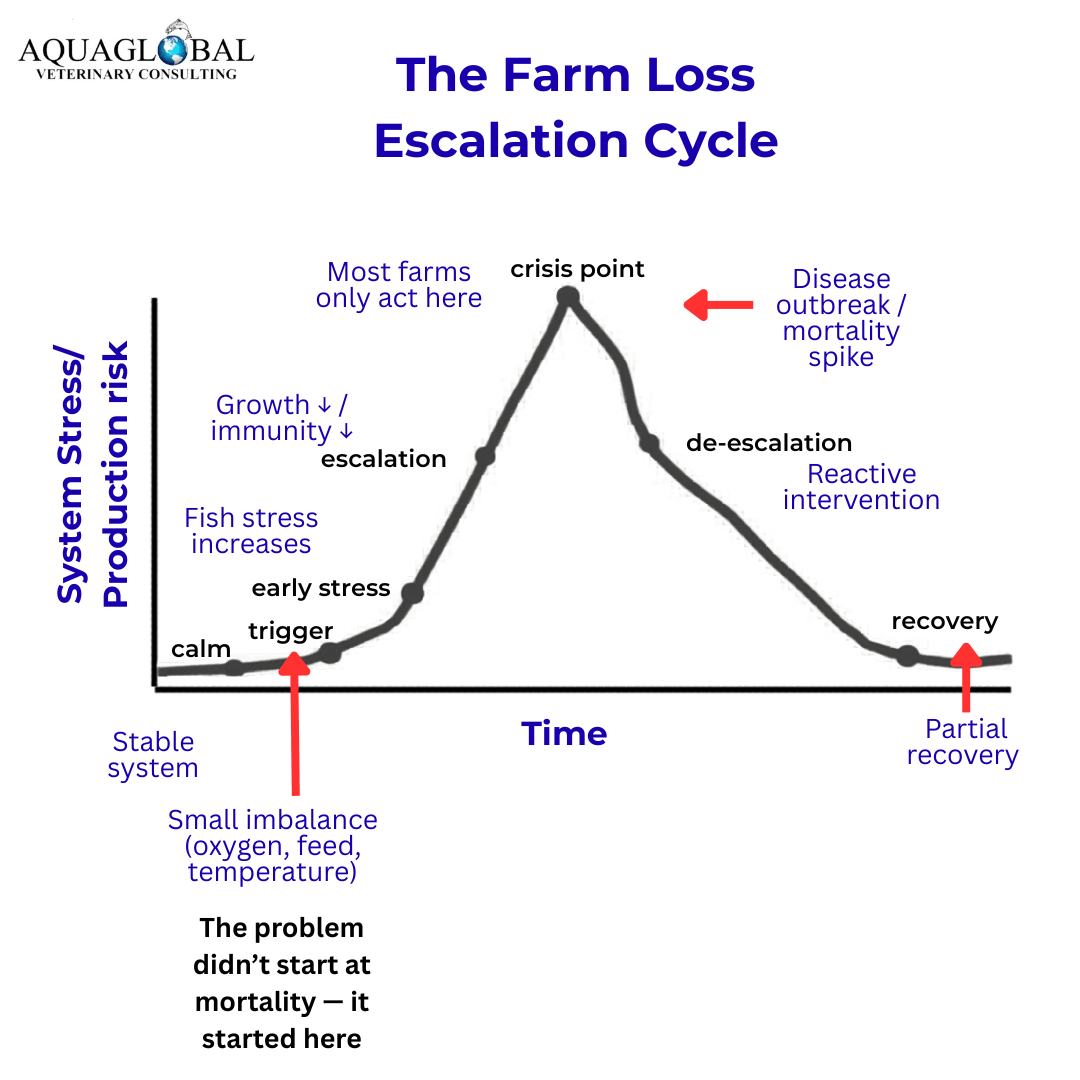
Most farm problems start earlier than people think
One of the biggest misconceptions in aquaculture is the idea that disease or mortality is the beginning of the problem. In reality, mortality is usually one of the last visible signs that something has already been going wrong inside the production system.
Long before animals begin dying, the system often shows earlier warning signs such as reduced feeding response, slower growth, mild behavioural changes, reduced feed conversion efficiency, water quality instability, increased stress, declining immunity, uneven fish sizes, chronic low-level mortality. The challenge is that these signs are easy to ignore because they do not yet feel like a crisis. Many farms continue operating normally during this stage, even though biological performance is already deteriorating beneath the surface.
The "stable system" phase
Every aquaculture farm begins in a relatively stable state. Animals are feeding. Growth is acceptable. Water quality appears manageable. Mortality is low. At this point, farms often feel comfortable and assume the system is functioning well.
However, aquaculture systems are dynamic and sensitive. Even small imbalances can begin pushing the system toward instability. These stressors may include :
◆ dissolved oxygen fluctuations
◆ poor feeding consistency
◆ overfeeding or underfeeding
◆ temperature changes
◆ organic waste accumulation
◆ poor water exchange
◆ high stocking densities
◆ biosecurity weaknesses
◆ handling stress
◆ nutritional imbalance
◆ environmental instability
On their own, these issues may appear minor but aquaculture losses rarely result from a single factor. They emerge when multiple small stressors accumulate and begin interacting with each other.
Early stress: the stage most farms miss
The early stress phase is often the most important stage in the entire cycle and also the stage most commonly overlooked. Aquatic animals may begin showing slight appetite reduction, lower activity levels, mild behavioural changes, increased stress responses, reduced growth efficiency, and subtle welfare decline.
At this stage, fish are already using energy to cope with stress instead of directing that energy toward growth, immunity, and performance. As stress continues immune function weakens, disease resistance decreases, feed efficiency declines, recovery capacity becomes reduced, and vulnerability to opportunistic pathogens increases.
This is where the cycle starts accelerating. Unfortunately, because mortality is still low, many farms delay intervention.
Escalation : when small problems become production losses
As stress builds, the system eventually reaches a tipping point. The farm now begins experiencing visible production losses such as poor growth performance, increased feed conversion ratios (FCR), chronic mortalities, greater disease susceptibility, uneven fish grading, reduced harvest quality, and increased operational pressure.
This stage is particularly dangerous because the farm often focuses only on the most obvious symptom.
For example, a disease outbreak may actually originate from chronic environmental stress; poor growth may reflect welfare and nutrition issues rather than feed quality alone; and recurrent mortalities may indicate management-system instability rather than a single pathogen. Without identifying the underlying drivers, interventions often become reactive instead of preventative.
The crisis point : where most farms finally act
The crisis point is where the problem becomes impossible to ignore. This is typically when farms call veterinarians, begin emergency treatments, increase chemical or pharmaceutical use, intensify monitoring, and attempt rapid corrective action.
Visible signs may include :
◆ disease outbreaks
◆ mortality spikes
◆ severe feeding suppression
◆ major water quality instability
◆ production crashes
◆ significant financial losses.
The problem is that by the time the farm reaches this stage, the biological and economic damage has often already been accumulating for weeks or months.
This is why reactive management is so expensive. By the crisis stage production efficiency has already declined, aquatic animal welfare has already been compromised, growth potential has already been lost, and recovery becomes slower and more costly.
Why some farms never fully recover
After intervention, farms usually enter a recovery phase. Mortality decreases, animals begin feeding again, water quality improves, and the system appears to stabilise.
However, many farms only achieve partial recovery because the root causes were never properly addressed.
Common unresolved drivers include weak monitoring systems, poor preventative management, nutritional imbalance, chronic environmental instability, inadequate biosecurity, staff training gaps, poor operational protocols, and overstocking pressure.
As a result, the same cycle repeats again later. The farm continuously moves from one crisis to another instead of building long-term stability.
High performing farms think differently
The best-performing farms are not necessarily the farms with the best emergency response. They are usually the farms that identify stress earliest. They focus heavily on prevention, monitoring, early warning indicators, water quality stability, welfare-focused management, nutrition optimisation, biosecurity systems, staff training, and data-driven decision making. These farms understand something extremely important: small stressors ignored today become major production losses tomorrow.
What farms should be monitoring closely
Strong aquaculture systems rely on early detection. Farmers, managers, veterinarians, and extension officers should monitor:
1. Fish behaviour, specifically feeding response, swimming behaviour, surface activity, grouping patterns, and stress responses.
2. Water quality, specifically dissolved oxygen, temperature, ammonia, nitrite, pH stability, and turbidity.
3. Production performance, specifically growth trends, feed conversion ratio, biomass changes, mortality patterns, and harvest quality.
4. Welfare indicators, specifically fin damage, gill condition, skin lesions, recovery after handling, and general stress indicators.
5. System stability, biosecurity compliance, equipment performance, waste accumulation, stocking density pressure, and environmental fluctuations.
Aquaculture requires a systems-based approach
One of the biggest lessons from the Farm Loss Escalation Cycle is that aquaculture problems are rarely isolated. Health, nutrition, environment, welfare, infrastructure, management, and operational decisions are all connected. This means successful aquaculture management cannot rely only on disease treatment, pharmaceuticals, feed changes, and emergency response.
Instead, farms need integrated systems that continuously support prevention, stability, monitoring, welfare, environmental management, and production optimisation. The goal should not simply be surviving the next outbreak. The goal should be building systems that reduce the likelihood of escalation occurring in the first place.
The role of aquatic veterinarians and extension officers
Veterinarians and extension officers play an essential role far beyond emergency disease response. Their greatest value often lies in helping farms detect hidden losses early, identify root causes, strengthen preventative systems, improve monitoring frameworks, support welfare-focused management, interpret production data, improve long-term resilience. Modern aquaculture increasingly requires proactive technical support rather than purely reactive intervention.
The most dangerous farm problems are often the ones that develop quietly.
By the time mortality appears, the system has usually already been under pressure for some time. Farms that consistently perform best are not the farms that wait for visible disaster before acting. These are the farms that detect stress early, monitor continuously, strengthen system stability, address root causes, and invest in prevention. Because in aquaculture, prevention is not simply about avoiding disease. It is about protecting growth, welfare, efficiency, profitability, and long-term sustainability.
Aquaglobal Veterinary Consulting supports aquaculture farms, producers, organisations, and aquatic animal health systems through a preventative and systems-based approach. If your farm is experiencing recurring losses, unexplained performance decline, disease pressure, or hidden inefficiencies, early intervention may prevent much larger production and financial losses later in the cycle. Contact us to learn how we can support your team.
Written by Sasha Saugh
Aquatic Veterinarian | Founder, Aquaglobal Veterinary Consulting