From Fasting to Slaughter—Understanding the Peri-harvest Journey
For months or even years, aquatic animals are carefully reared. Farmers monitor water quality, nutrition, health, growth and biosecurity to produce healthy animals and high-quality food. Yet one of the most important stages of production often receives far less attention than the production cycle that came before it: the peri-harvest period—the hours or days immediately before, during and after harvest.
For the purposes of this series, the peri-harvest period includes the activities occurring immediately before harvest (such as fasting and crowding), during harvest (including capture and handling), and immediately after harvest (which may include further handling, transport, holding, stunning and slaughter, depending on the species and production system).
Why the peri-harvest period matters
Harvest is often viewed simply as the point at which animals leave the production system. In reality, it is a carefully managed sequence of interconnected activities, each with the potential to influence welfare outcomes. Although the peri-harvest period may range from a few hours to several days, it exposes aquatic animals to multiple potential stressors within a relatively short period of their lives. Scientific evidence has consistently shown that animal welfare may be compromised if the different stages are not carefully managed.
Research has identified a range of welfare concerns associated with the peri-harvest period, including :
Physiological stress resulting from repeated handling, crowding and transport.
Physical injuries, including scale loss, bruising, fin damage and skin lesions caused by inappropriate handling or equipment.
Poor water quality during crowding and transport, particularly reduced dissolved oxygen and elevated carbon dioxide or ammonia concentrations.
Mortality during handling and transport, which may increase when animals are already compromised by disease or environmental stress.
Ineffective stunning, resulting in some animals remaining conscious during slaughter.
Reduced product quality, with pre-slaughter stress influencing rigor mortis, flesh texture, colour, water-holding capacity and shelf life.
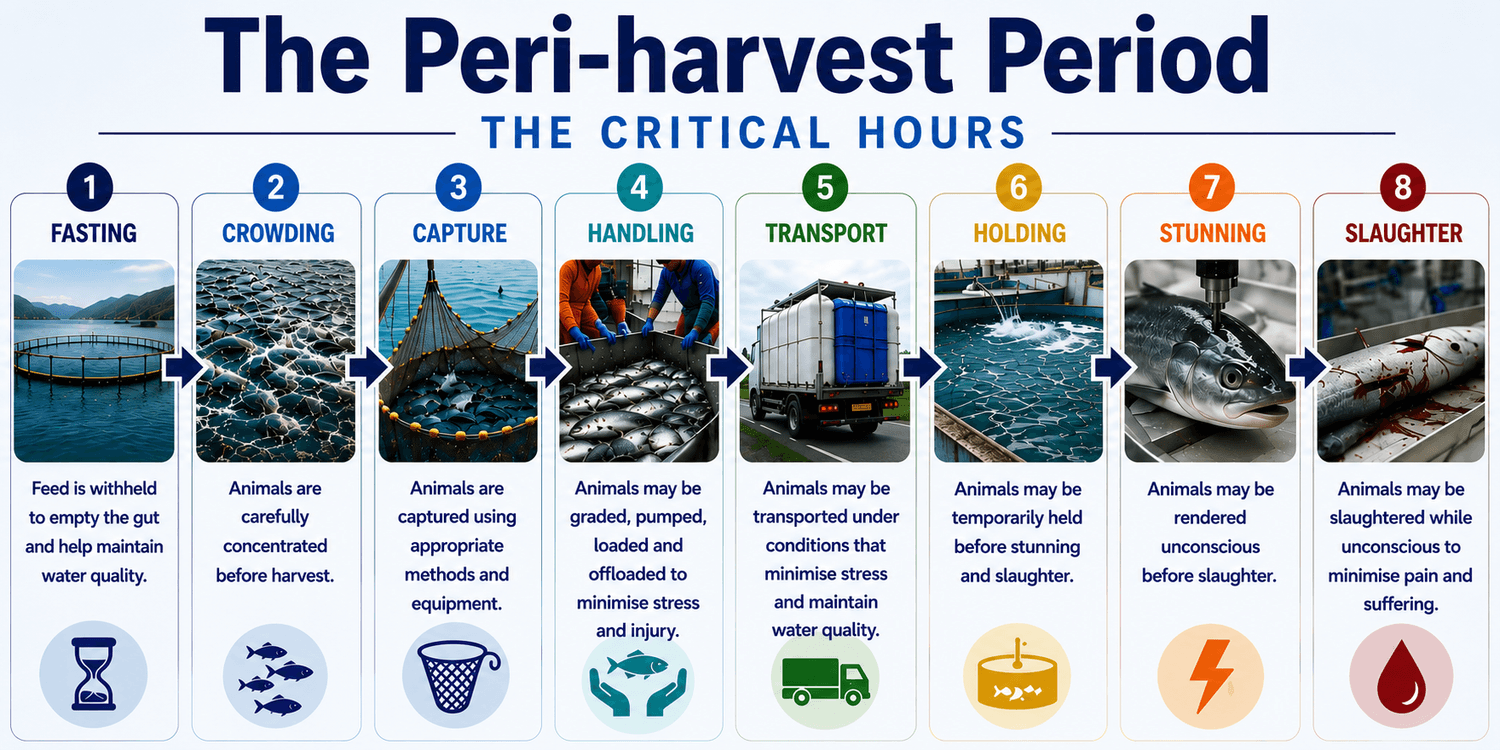
Withholding feed before harvest, for example, is a common practice that helps empty the digestive tract, maintain better water quality, and prepare animals for handling and transport. It can also improve product quality by reducing the risk of contamination during processing and helping to delay spoilage. However, fasting needs to be carefully managed. If it continues for too long, it may compromise animal welfare, and research suggests that commonly used fasting periods for some species are often based more on industry tradition than robust scientific evidence.
Crowding is usually unavoidable because animals need to be gathered before capture. Yet it is also one of the most consistently recognised sources of stress during the peri-harvest process. This stress can be compounded during capture, handling and transport if these procedures are not carefully managed.
Where harvesting is followed by processing, additional stages such as holding, stunning and slaughter introduce further welfare considerations. The effectiveness of stunning, the time to slaughter, and the methods used all influence the animal's final experience.
Importantly, these stages should not be viewed as isolated events. The stress experienced by animals during one stage may compound the effects of those that follow, making the management of the entire peri-harvest process just as important as any individual procedure.
Stress experienced during the peri-harvest period can also influence product quality by affecting muscle chemistry, the onset of rigor mortis, fillet texture, water-holding capacity and appearance. In many cases, practices that improve welfare also improve product quality, making good welfare not only an ethical responsibility but also sound business practice.
For producers, effective peri-harvest management can help reduce mortalities and injuries, improve product quality and consistency, minimise losses and downgrades, support compliance with customer and certification requirements, and strengthen consumer confidence in aquaculture products.
More than a single event
The peri-harvest process should be viewed as a sequence of interconnected activities, each with the potential to influence animal welfare. Many welfare improvements are already achievable through practical procedures. Rather than viewing harvest as an isolated event, we should think of it as a journey in which every decision influences the next.
Why we need to learn from real farms
Scientific research tells us what can influence welfare during the peri-harvest period, but it rarely shows what the process actually looks like on commercial farms.
Every farm operates differently, and various factors shape how animals are harvested. These may include species, infrastructure, geography, market requirements, environmental conditions, and available technology. Some operations use pumps, others brails or nets. Some transfer animals directly into transport systems, while others use temporary holding facilities before processing. Stunning and slaughter methods also vary considerably between species and production systems.
There is enormous value in documenting these real-world practices.
Sharing visual documentation of peri-harvest practices is not about judging or criticising producers. Rather, it provides an opportunity to better understand the diversity of peri-harvest practices across different species, production systems and regions, identify practical innovations, showcase good practices, and promote continuous improvement throughout the industry. It helps create a trusted, evidence-informed visual resource that supports learning, collaboration and the advancement of aquatic animal welfare.
It is only by understanding what actually happens on farms that we begin to identify opportunities to improve aquatic animal welfare in ways that are practical, achievable and scientifically informed.
A new series
This article marks the beginning of the Aquaculture Peri-harvest Insights series.
This series will explore every stage of the peri-harvest journey. Drawing on scientific evidence, practical experience and real-world case studies, the aim is to better understand how these interconnected stages influence aquatic animal welfare and to highlight practical opportunities for improvement across different species and production systems.
Invitation to contribute
We are beginning an initiative to document peri-harvest practices from aquaculture systems around the world.
If you are a farmer, veterinarian, researcher, processor or aquaculture professional, we would be delighted if you would consider sharing photographs, short or long videos showing any part of the peri-harvest process.
Good practices, innovative solutions and everyday realities are all valuable.
The objective is not to identify perfect systems, but to build a visual repository that helps the global aquaculture community learn from one another, supports research, training and continuous improvement across the aquaculture industry. The photographs and videos received will be used to advance understanding of peri-harvest practices across different aquaculture systems. They may be used for education and training, scientific research, professional presentations, conference lectures, awareness campaigns, publications, online learning resources, and the development of practical guidance to support continuous improvement in aquatic animal welfare. Where appropriate and with permission, examples may also be used to showcase innovative practices, illustrate common welfare challenges, and promote evidence-based discussion across the aquaculture community.
As a contributor, you will help create a lasting resource that supports the advancement of aquatic animal welfare. With your permission, contributors will be acknowledged, and gain access to selected educational resources developed through this work.
If we want to improve aquatic animal welfare during the peri-harvest period, we must first understand what actually happens on farms during this critical stage of production.
Every photograph. Every video. Every farm. Together, they help tell the story of the peri-harvest journey.
For contributions, questions or queries, please email support@aquaglobalvet.com with a subject heading "Aquaculture Peri-harvest Insights".